What is Keyword Density?
Keyword density is the percentage of times a target keyword appears in your content relative to the total word count. For example, if you write a 1,000-word article and your target keyword appears 10 times, your keyword density is 1%.
The formula is simple:
Keyword Density = (Number of times keyword appears / Total word count) × 100
While it sounds straightforward, keyword density is one of the most debated topics in SEO. Used correctly, it helps Google understand what your content is about. Used incorrectly, it can get your pages penalized.
Why Keyword Density Matters for SEO
Search engines like Google use keyword frequency as one of many signals to determine what a page is about. When Google crawls your page, it analyses the text to understand the topic. If your target keyword appears naturally throughout the content, Google is more confident about what the page covers and ranks it accordingly.
However, keyword density is not a ranking factor on its own. Google's algorithms are far more sophisticated than simply counting keyword appearances. They evaluate semantic relevance, user intent, content quality, backlinks, and hundreds of other signals. Keyword density is a baseline signal — necessary but not sufficient on its own.
What is the Ideal Keyword Density?
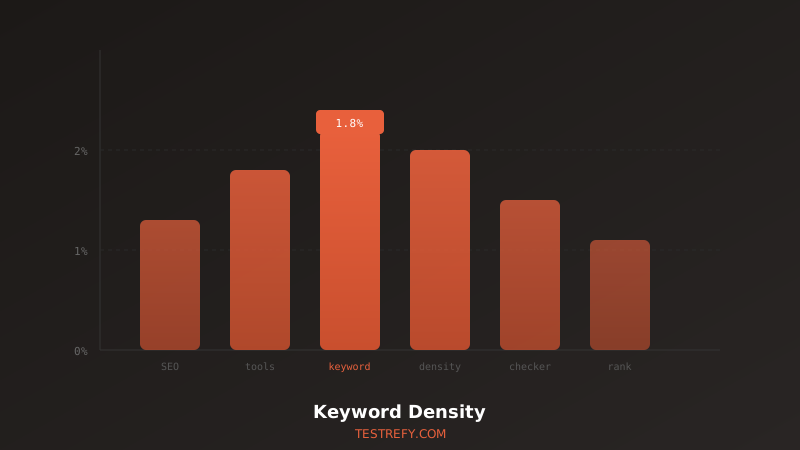
There is no universally agreed ideal keyword density, but most SEO professionals target between 1% and 2%. This means for a 1,000-word article, your primary keyword should appear roughly 10 to 20 times.
Here is a practical breakdown:
- Under 0.5%: Too low — Google may not clearly associate your page with the keyword.
- 0.5% to 1%: Acceptable for highly competitive keywords where over-optimisation is a risk.
- 1% to 2%: The sweet spot for most content types and keyword targets.
- 2% to 3%: Borderline — acceptable if it reads naturally, but monitor carefully.
- Above 3%: Danger zone — risks keyword stuffing penalties from Google.
These are guidelines, not rules. A well-written 2,000-word technical guide may naturally hit 1.5% keyword density without any deliberate effort. The key is that your content should read naturally for human visitors first and search engines second.
Keyword Stuffing: What to Avoid
Keyword stuffing is the practice of unnaturally forcing keywords into content to manipulate search rankings. Google's Panda algorithm update, first introduced in 2011 and continuously refined since, specifically targets keyword stuffing and thin content.
Examples of keyword stuffing include repeating the same phrase in every sentence, hiding keywords in white text on a white background, adding irrelevant keywords in meta tags, and forcing unnatural keyword variations into headings. Modern Google is extremely good at detecting these tactics. Sites caught keyword stuffing face significant ranking drops or complete removal from search results.
LSI Keywords and Semantic SEO
Modern SEO has moved beyond single keyword density toward semantic relevance. Latent Semantic Indexing (LSI) keywords are terms and phrases that are conceptually related to your main keyword. For an article about keyword density, LSI keywords include search engine optimisation, content writing, on-page SEO, meta tags, SERP rankings, and word count.
Google uses these related terms to build a complete picture of your content's topic. A page that only repeats its exact target keyword over and over looks suspicious. A page that naturally incorporates related terminology reads as authoritative and comprehensive — which is exactly what Google wants to rank.
When writing content, ask yourself: what words and phrases would an expert naturally use when discussing this topic? Include those naturally throughout your content alongside your primary keyword.
How to Check Keyword Density
Manually calculating keyword density is tedious and error-prone, especially for long-form content. The most reliable approach is to use a dedicated keyword density checker tool that automatically analyses your text and returns an accurate percentage instantly.
Our free Keyword Density Checker at Testrefy lets you paste any text and instantly see the density of every keyword in your content. It highlights overused terms, identifies keyword distribution across sections, and helps you optimise without guesswork. No signup required and your content never leaves your browser.
To check keyword density effectively:
- Paste your complete draft into the tool before publishing
- Check your primary keyword density — aim for 1% to 2%
- Look for any unintentionally overused words that might trigger spam filters
- Verify that related keywords and synonyms are present throughout
- Adjust your content based on the results before finalising
Keyword Density for Different Content Types
Different types of content have different natural keyword density patterns. Blog posts and guides typically achieve 1% to 1.5% naturally when written well. Product pages tend to have higher density (1.5% to 2%) because the product name is referenced repeatedly. Landing pages can go up to 2% because they are focused on a single topic. Long-form pillar content (3,000+ words) often has lower density (0.8% to 1.2%) because the topic naturally expands into subtopics.
The best approach is to write your content naturally, check the density with a tool, and then make minor adjustments if needed. Never write for a target density number — write for your reader first.
On-Page SEO Beyond Keyword Density
Keyword density is just one element of effective on-page SEO. To maximise your chances of ranking, combine proper keyword usage with these additional factors. Your primary keyword should appear in the page title, the first H1 heading, the meta description, the first 100 words of content, at least one subheading, and the URL slug. Image alt text should describe the image and can include the keyword where relevant. Internal links to related content help Google understand your site structure and distribute page authority effectively.
Common Keyword Density Mistakes
The most common mistake is obsessing over hitting an exact density percentage instead of writing quality content. Another frequent error is using the exact same keyword phrase repeatedly instead of natural variations. For example, instead of repeating "keyword density tool" ten times, naturally vary it with "keyword checker," "keyword frequency analyser," and "check keyword percentage." This reads better for humans and signals broader semantic relevance to Google.
Finally, many writers focus only on the body text and ignore keyword placement in title tags, meta descriptions, headings, and image alt attributes — all of which carry significant weight in Google's assessment of page relevance.
Conclusion
Keyword density remains a useful baseline metric for on-page SEO, but it should never be your primary focus. Aim for 1% to 2% for most content, write naturally and for your human readers first, and use a keyword density checker to audit your work before publishing. Combined with strong semantic coverage, quality content, and proper technical SEO, keyword density is one piece of a winning on-page strategy.
Use our free Keyword Density Checker to analyse your content instantly — no signup, no limits, completely free.